Plan, allowance and billing
Three screens, and only the first is open to everybody.
Allowance
How much of each thing is left, and where the ceiling comes from. Every member of the workspace can read it, because "have we run out of renders" is a question about the day's work rather than about money.
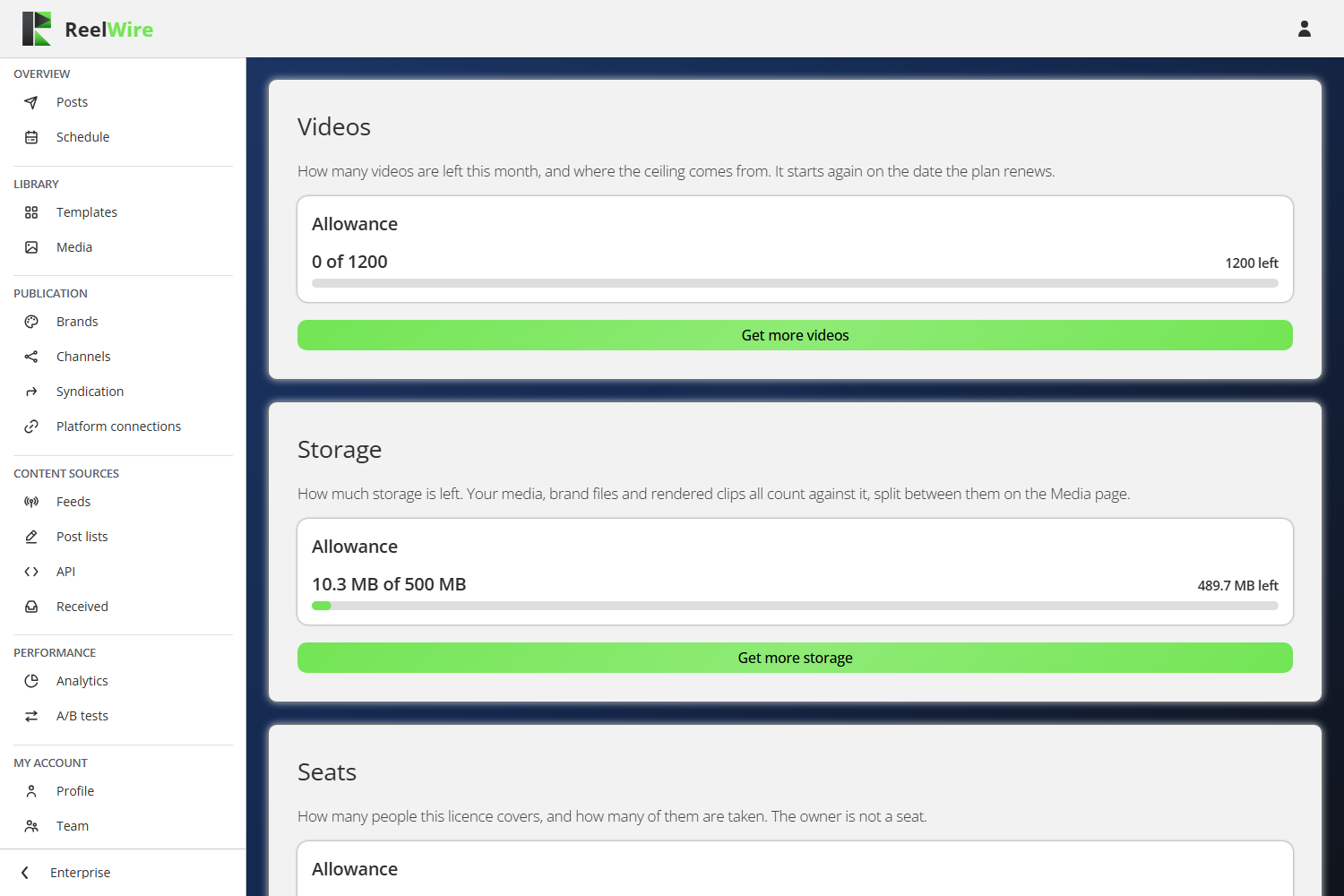
There is one card per allowance your plan actually has: videos, storage, seats and syndication partners. An allowance your plan does not include is not drawn, because a meter reading nought of nought is a question about something you do not have.
Each card breaks the ceiling into what the plan includes, what you added, and anything Reelwire granted. That matters when the number is not what you expected: the three parts say which of them to change.
Videos start again on the date your plan renews, not on the first of the month.
One video is one unit of the allowance. A post going to three channels in three languages is three videos, because it is three files drawn.
A video in the ordinary pipeline is counted when it is queued, not when the file lands, so the allowance cannot be run past by queueing more than it holds. A direct export is counted only once it succeeds, so a cancelled one costs nothing.
The small indicators at the top right of other screens are the same numbers seen where they bite. The ? beside each one lands on the matching card here.
Plan
The owner's screen, and the only one that can take the product away from everybody else.
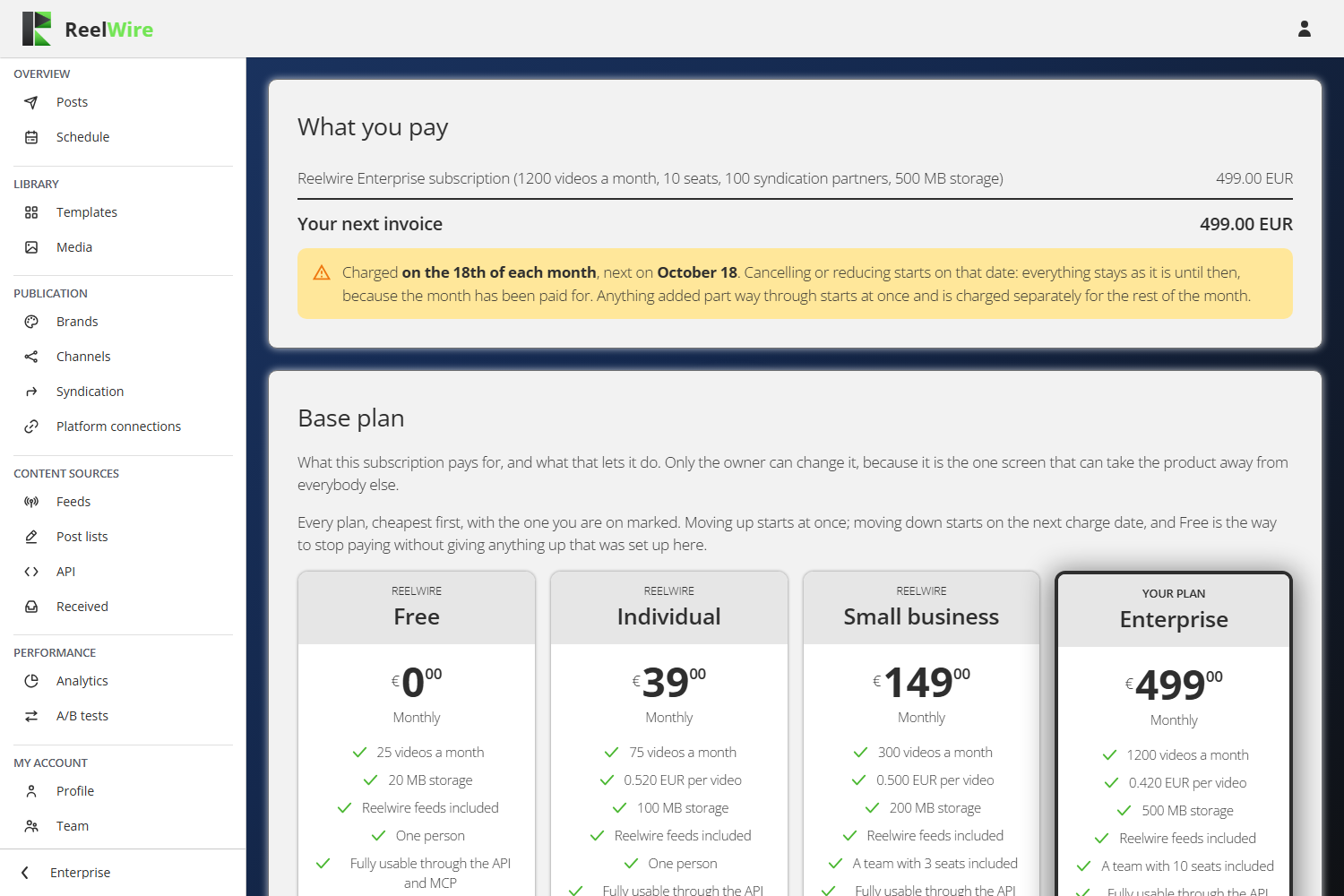
There are four tiers. Moving up takes effect at once and the difference for the rest of the cycle is charged straight away as its own payment. Moving down starts on the next charge date, because the period you are on has been paid for.
| Tier | What it adds |
|---|---|
| Free | Reelwire's own feeds and post lists. One person. Every clip carries a Reelwire mark. |
| Individual | No watermark, and more of the render allowance. |
| Small business | A team, and the analytics screens. |
| Enterprise | A/B tests, syndication and priority rendering. |
The API and the MCP server are on every tier, Free included. What a tier sells is render allowance, storage, seats and the screens above, never whether the product can be driven from your own code. A key on Free carries the same permissions as a key on Enterprise and reaches the same endpoints, and an assistant on the MCP server is that key with better manners.
There is no Cancel button, and that is not an oversight. Free grants exactly what a cancelled workspace granted, so the product had two names for one place. Moving to Free is how you stop paying, and it gives up nothing that was set up here: channels, brands, sources and media stay where they are.
Before a downgrade lands, the dialogue lists what you lose and names only the things you actually hold. Nothing is deleted by a downgrade. Over the storage ceiling, uploads are refused until you are under it again; over the seats, nobody is signed out.
Below the tiers is what can be bought on top: more videos, storage, seats and syndication partners. Videos are sold as a block you move between sizes, because giving back half a block is not something anybody can ask for. The others are quantities that add up.
At the foot, Billing term switches between monthly and yearly. A year costs ten months, so two are free. Going yearly starts today and is charged today; going back to monthly takes effect when the year ends, because the discount is what paid for the commitment. It is the charge that becomes yearly, not the allowance: videos still arrive a month at a time.
A trial workspace has neither of these two screens. Nobody bought it and nobody is charged for it, so there is no subscription for them to change.
Billing
The owner's screen as well: the payment method, the address your invoices are made out to, and every invoice so far.
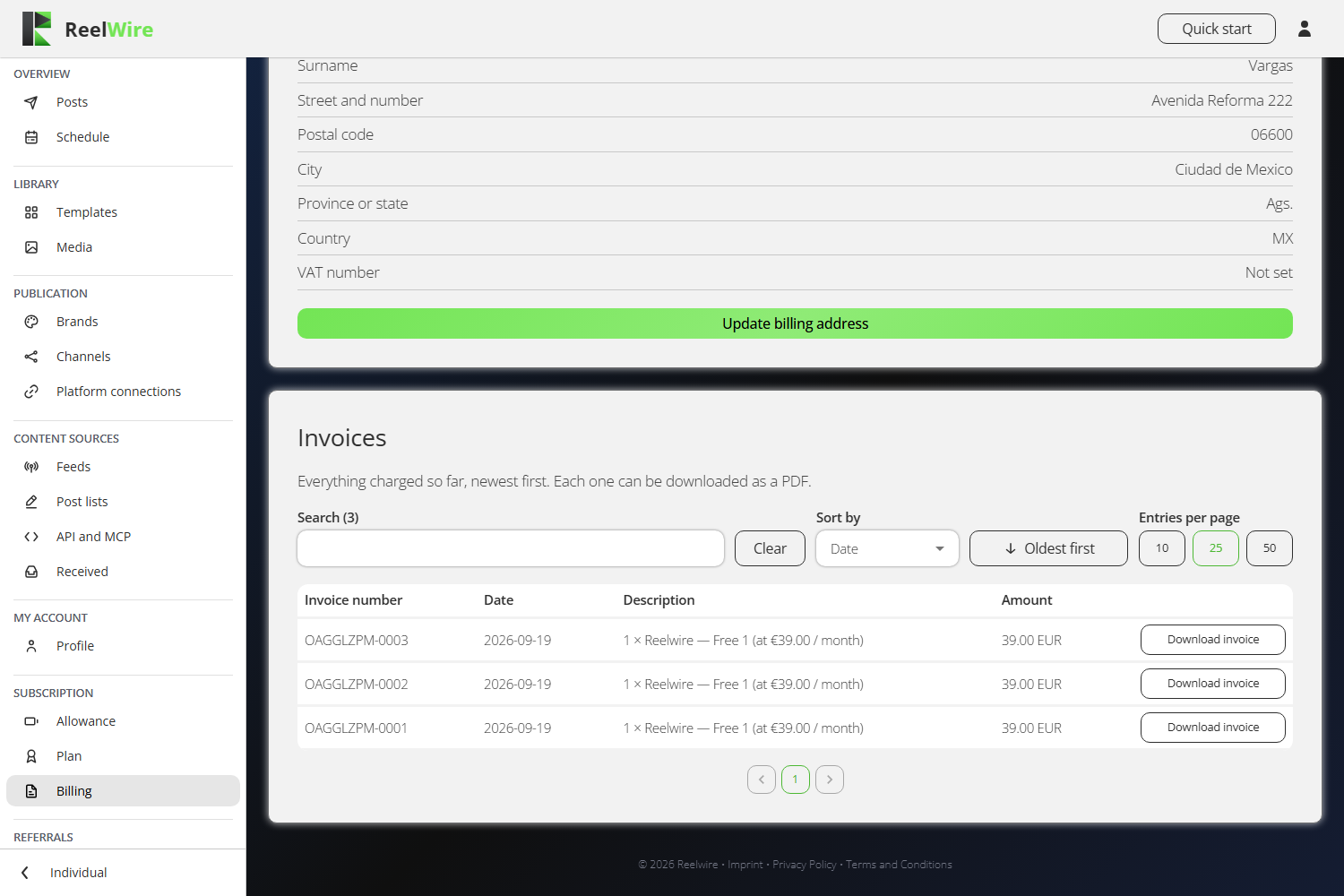
The card and the billing address are the ones you gave Stripe when you paid, brought back here so the screen can show them. Changing the address applies to invoices from here on; ones already issued keep the address they were sent with, because a document that changes after the fact is not a record of anything.
The invoices are Stripe's. Reelwire does not raise documents of its own: Stripe numbers them, addresses them, itemises the tax and hosts both a web page and a PDF. Download invoice opens Stripe's copy, which is the same document your accountant would get from us and goes on working years later.
Prices are before tax. The figure on the plan cards is what Reelwire is paid; VAT is added on top at the rate of the country on your invoice address, and the checkout shows the total before anything is charged.
A business pays the figure on the card. Give a valid VAT number at the checkout and the reverse charge applies: no tax is added, and you account for it yourself. That is the reason prices are quoted this way rather than tax included, where a business would pay the same total as a consumer with nothing to reclaim.
Invoices are searched with one box rather than four filters, and it matches what is printed: the formatted date and the formatted amount as you see them, the invoice number and the description.